Boswellia Is in Your Pain Relief Oil. It’s Also in Clinical Trials for Arthritis. Why Isn’t Anyone Talking About This?
Boswellia serrata — Indian frankincense — has been tested in real clinical trials for arthritis, and the results are good. A 2024 study found measurable improvement in knee pain within just five days. The reason it works is well understood: it blocks a specific inflammation switch in the body, through a mechanism that’s gentler on your stomach than most painkillers. That’s not a wellness claim. That’s peer-reviewed research.
Every pain relief oil will tell you it contains ‘Ayurvedic herbs.’ Most of them will leave it at that. They’ll use words like ‘ancient,’ ‘time-tested,’ ‘trusted for generations’ — and stop there, because explaining what’s actually going on is harder.
Boswellia is one ingredient that deserves more than that shortcut. It’s been studied in proper clinical trials — the kind with control groups and published results — for knee pain, lower back pain, and arthritis. The reason it works is genuinely interesting. And the fact that Ayurvedic practitioners figured it out a few thousand years ago, before any of the science existed, is one of those things that should make us pay closer attention to traditional medicine, not less.
Here’s everything worth knowing.
What Boswellia actually is
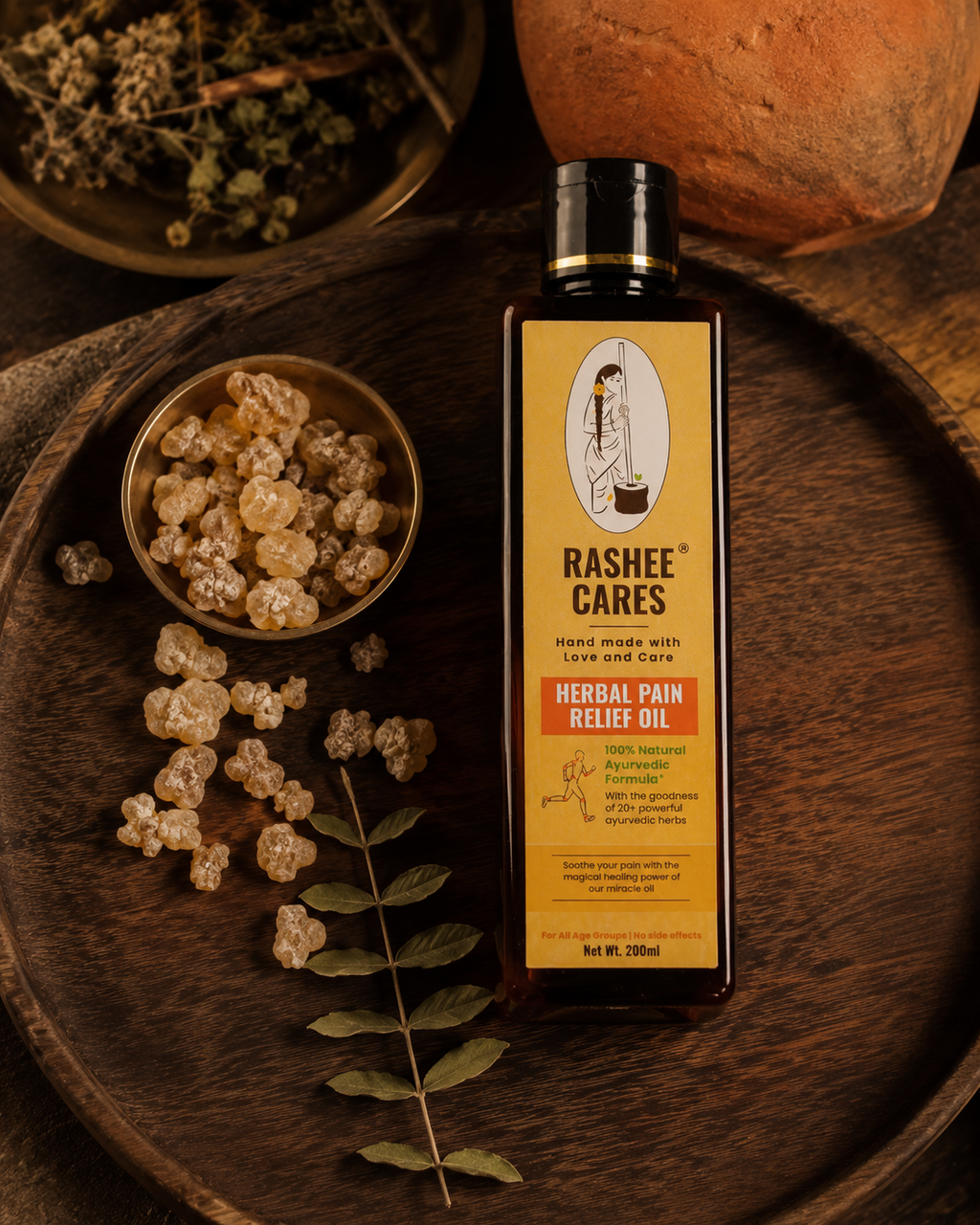
Boswellia serrata is a tree that grows in the dry, rocky hills of India — mainly Rajasthan, Madhya Pradesh, and Andhra Pradesh. It belongs to the same plant family as myrrh. When you cut the bark, it produces a thick, fragrant resin. That resin is the medicine.

In Ayurveda, it’s called Shallaki. The Charaka Samhita and Sushruta Samhita — two foundational Ayurvedic texts written over two thousand years ago — describe it specifically for joint pain, bone problems, and inflammation. Practitioners used to mix it into warm oil and apply it directly to painful joints. They also boiled it in milk and drank it.
Both of those methods, it turns out, were clever. Warm oil opens up the skin and helps active compounds absorb. Milk fat helps the body digest and absorb the resin’s active ingredients, which don’t dissolve easily in water. The practitioners didn’t know the chemistry behind it. But they had figured out the right delivery method through generations of observation — which is its own kind of sophisticated.
How it works — explained without the jargon
Your body has an inflammation system. When you hurt yourself, or when joints are worn down by arthritis, that system activates and sends chemical signals that cause swelling, heat, and pain. It’s a protective response. But in chronic conditions like arthritis, it becomes overactive — the body keeps inflaming tissue that doesn’t need to be inflamed anymore.

Most common painkillers — ibuprofen, aspirin, diclofenac — work by blocking one part of that inflammation system. They’re effective, but blocking that particular part has a side effect: it also reduces a protective coating in your stomach lining, which is why long-term painkiller use can cause stomach ulcers and GI problems.
Boswellia works differently. It blocks a different switch in the same inflammation system — one that doesn’t touch the stomach lining. The body’s inflammation response has multiple pathways, and Boswellia targets one that painkillers mostly don’t. That’s why researchers are interested in it: it produces real anti-inflammatory effects through a route that’s gentler on the gut.
The specific compound responsible is called AKBA, which you don’t need to remember — just know it’s been isolated, studied extensively, and confirmed as the active ingredient. A 2025 review in Frontiers in Pharmacology called it the most potent anti-inflammatory compound found in the Boswellia plant.
What the clinical trials actually found
This is the part that gets overlooked. Boswellia has actual trial data. Not one small study from thirty years ago — several recent, well-designed trials with published results.
Better sleep, not just less pain (2023)
A trial published in Nutrients in 2023 tested Boswellia on 120 people with persistent knee discomfort over eight weeks. The headline result was that it improved sleep — specifically, how long it took people to fall asleep. That might sound like a minor finding, but it isn’t. Chronic pain and poor sleep feed into each other in a cycle that’s genuinely hard to break. A compound that takes the edge off both is more useful than one that only addresses the pain score.
Lower back pain relief (2025)
A 2025 trial published in Explore gave 90 people with chronic lower back pain a combination of Boswellia and turmeric (curcumin) for 90 days. Pain, disability scores, and inflammatory markers all improved significantly compared to placebo. The combination works well because the two herbs target inflammation through different but complementary routes — turmeric handles one part of the process, Boswellia handles another.
Five-day improvement in knee arthritis (2024)
A study published in Frontiers in Pharmacology in 2024 ran for 90 days across two hospitals in India — Guntur and Mysore. It was double-blind and placebo-controlled, which means neither the participants nor the researchers knew who was getting the real treatment. The 105 participants had knee osteoarthritis. Within five days, the Boswellia groups showed measurable improvement in pain and movement. By the end of the trial, X-rays showed actual changes in joint space — a physical sign of reduced inflammation, not just reported pain relief. Blood markers of inflammation also dropped significantly.

So why is it in a topical oil, not a capsule?
Fair question. Most of the trial data above is for Boswellia taken by mouth. So what’s it doing in a pain relief oil you rub on your skin?
Here’s the thing: Boswellia’s active compounds are oily by nature. They don’t dissolve in water — they dissolve in fat. That’s actually a problem for oral supplements, because your digestive system is mostly water-based and doesn’t absorb them efficiently. It’s why traditional Ayurvedic preparations used oil and milk as carriers — fat helps get the active compounds into the body.
For topical use, this becomes an advantage. In an oil-based formulation, Boswellia’s active compounds are already in the medium they’re designed for. They can absorb through the skin more readily than they would through a water-based cream. Pharmaceutical researchers are now actively developing specialised lipid (fat-based) delivery systems specifically to get Boswellia compounds through the skin and into inflamed joint tissue — which is confirmation that transdermal delivery is a real route, not just a traditional assumption.

The honest answer is that rubbing oil on a joint is not the same as taking a standardised capsule. The dose, the absorption, and the mechanism are different. We’re not claiming our pain relief oil does what 300–600 mg of Boswellia extract taken twice daily does in a clinical trial. That would be misleading.
What we can say is that the active compounds in Boswellia have a real, well-characterised mechanism. They’re in the right medium in an oil-based formula. And classical Ayurvedic practitioners — who used exactly this delivery method for exactly this purpose — were not wrong. They just couldn’t explain the chemistry. We can.
What Rashee Cares does with this
We put Boswellia in our pain relief oil because we trust the mechanism, the tradition, and increasingly, the trial record. We also think people deserve to know what’s in their products and why — not just that something is ‘Ayurvedic.’
If you’re dealing with serious joint pain or arthritis and you want to try Boswellia properly, an oral supplement is the more studied route. Look for a standardised extract with at least 30–40% boswellic acids, and talk to your doctor before starting. That’s a different decision from a topical oil, and it should be made with more information.
But if you want a pain relief oil where every ingredient has a reason to be there — and where that reason goes deeper than ‘traditional’ — that’s what we’re building.
The bigger point
There’s a pattern with Ayurvedic ingredients. Science eventually catches up to them. Turmeric spent decades being dismissed as cooking spice before curcumin research exploded. Ashwagandha was ‘stress herb’ before the cortisol data came in. Boswellia is going through the same arc right now — from ancient resin to active clinical trial subject.
The wellness industry mostly ignores this arc. It picks the traditional story or the clinical story, but rarely connects them. We think the connection is the interesting part. The fact that a tree resin described in a Sanskrit text two thousand years ago is now being tested in randomised controlled trials and showing up in pharmaceutical nanocarrier research — that’s not a coincidence. It’s what happens when good traditional medicine meets modern method.
That conversation is worth having. We thought we’d start it.
References
Majeed, M. et al. (2024). A standardized Boswellia serrata extract shows improvements in knee osteoarthritis within five days. Frontiers in Pharmacology, 15. https://doi.org/10.3389/fphar.2024.1428440
Pérez-Piñero, S. et al. (2023). Efficacy of Boswellia serrata Extract for Improving Pain and Function in People with Persistent Knee Pain. Nutrients, 15(17), 3848. https://doi.org/10.3390/nu15173848
Majumdar, A. et al. (2025). Boswellia serrata and Curcuma longa for chronic lower back pain. Explore, 21(1), 103099. https://doi.org/10.1016/j.explore.2024.103099
Sailer, E.R. et al. (1996). Acetyl-11-keto-β-boswellic acid (AKBA): structure requirements for 5-lipoxygenase inhibitory activity. British Journal of Pharmacology, 117(4). https://doi.org/10.1111/j.1476-5381.1996.tb15235.x
Singh, G.B. et al. (2025). From bench to bedside, boswellic acids in anti-inflammatory therapy. Frontiers in Pharmacology / PMC. https://pmc.ncbi.nlm.nih.gov/articles/PMC12669112/
Mishra, M. et al. (2023). AKBA in lipid nanocarriers for topical delivery. ScienceDirect. https://doi.org/10.1016/j.jsps.2023.101848
American Botanical Council. Boswellia serrata: Clinical Trials summary. https://www.herbalgram.org/resources/herbmedpro/herb-list/boswellia-serrata